
From hydropower in the Bernese Oberland and the wind farm in southern Italy to battery storage and the extra-high-voltage line in Germany: As part of its “Solutions 2030” strategy, BKW is implementing targeted projects in Switzerland and Europe that address the demands of society and the economy for the energy system of the future. BKW plans to invest a total of CHF 4 billion in this area by 2030 – half of which will be in Switzerland.
More electricity from renewable energies
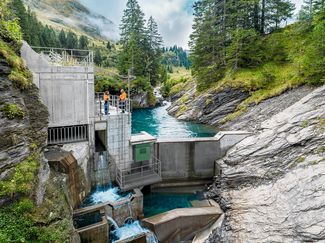
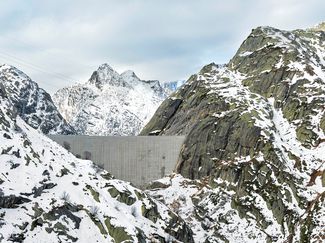
These investment projects also include the hydropower plants on Lake Grimsel in the Bernese Alps. Lake Grimsel is the most important reservoir in the extensive power plant network of Kraftwerke Oberhasli AG (KWO), half of which is owned by BKW. Its storage capacity can supply around 100,000 households per year. This example shows how the expansion of existing infrastructure and expansion projects go hand in hand with electricity production: On the one hand, the Spitallamm replacement dam on Lake Grimsel was dedicated last June. The project cost a total of around CHF 125 million. The new construction was necessary because the existing dam from the 1930s was in need of renovation. It measured 114 meters from foundation to crown, making it one of the highest dams in the world at the time it was built. The new dam now stands in front of the old one – and is approximately the same height as the old one. However, with the Lake Grimsel enlargement project, the dam wall could be raised by 23 meters in the future. It is one of 16 projects selected by the Swiss government for the expansion of domestic electricity production from hydropower. KWO submitted a concession application for this project to the cantonal authorities in May 2024. By raising the Spitallamm dam and enlarging Lake Grimsel, the power plant could store an additional 240 gigawatt-hours of electricity per year. The expansion project, which is estimated to cost around CHF 300 million, will therefore contribute to electricity production in the winter months in particular, when less electricity is generated from run-of-river and solar power in Switzerland.
BKW is also investing in run-of-river power: Current projects include the construction of the new Sousbach hydropower plant for around CHF 69 million. The plant went into operation at the end of 2025 and supplies around 6,700 households with renewable electricity. In addition, BKW will start the complete renovation of the Mühleberg hydropower plant in 2028. It is investing a total of around CHF 120 million in this project.
In addition to hydropower, BKW is also driving forward with wind turbines. Here, BKW connected the Cerignola wind farm in Puglia in southern Italy to the power grid at the end of 2025 (Cerignola North) and at the beginning of 2026 (Cerignola South) after just under a year of construction. The 29 turbines supply enough electricity for 140,000 households every year. With 800 landowners, two substations, and 27 kilometers of high-voltage line, this is a complex infrastructure project – and currently BKW’s largest construction project abroad. Its completion marks an important step in the “Solutions 2030” strategy, with which BKW intends to expand its portfolio by over 600 megawatts of renewable electricity production by 2030 and reduce emissions in the Energy business to net zero by 2040.
Increasing demand for flexibility in the energy system
Expanding or building new wind turbines, hydropower plants, and solar power plants is an important prerequisite for the success of the energy transition. Yet another is that the electricity produced by these systems is available in the right quantity, at the right time, and in the right place. This also requires flexibility because the increase in renewable energy sources, especially wind and solar power, also increases the fluctuations in electricity production. This is literally dependent on wind and weather – that is, the time of year and time of day, as well as the meteorological conditions. Flexibility and storage solutions are therefore needed to tackle the energy transition holistically. This opens up exciting growth opportunities for BKW – thanks to its broad range of expertise in production, marketing, and distribution, and the use of energy. With its “Solutions 2030” strategy, BKW aims to build its own flexibility systems, such as hydropower plants and batteries, with a capacity of over 600 megawatts by 2030. On the other hand, it wants to manage flexible third-party plants of over 700 megawatts and, as a pooler, connect micro-plants of over 200 megawatts to virtual, flexible power plants. BKW has already launched some ambitious projects in these areas: In Waltrop, Germany, BKW expects to begin construction of a large-scale battery with an output of 300 megawatts and a storage capacity of 600 megawatt-hours at the end of 2026. BKW’s investment of around EUR 200 million includes the development, construction, and operation of the large-scale battery storage facility. The plant will serve to stabilize the energy system in an increasingly volatile energy market. At the same time, BKW is strengthening its activities on the international energy markets, where on-demand electricity storage is becoming increasingly important.
Also in Germany, a battery is currently being built in Holenbrunn (Wunsiedel), which BKW will plan, build, and operate. Last fall, BKW also signed a long-term financing agreement with Zelestra, a global renewable energy company. This will enable the construction of a large battery in northern Italy with a storage capacity of up to two gigawatt-hours. Construction is scheduled to begin in 2027, with full operation planned for 2028. Zelestra will provide BKW with some of the plant’s production capacity in order to manage and optimize flexibility on the market. The approach for this large-scale project is highly innovative, as it combines an improvement of power grid flexibility with faster integration of renewable energies, helps to decarbonize Italian power generation, and increases security of supply.
BKW also holds a stake in the Grimsel 4 pumped-storage power plant through KWO. KWO submitted the building permit for this underground expansion project at the end of 2024, construction is scheduled to start in summer 2026, and commissioning is planned for around 2031. With a total investment of around CHF 250 million, Grimsel 4 will make more efficient use of the water between the two existing reservoirs at Lake Grimsel and Räterichsbodensee. Two new pump turbines with a total output of 150 megawatts are planned between the two reservoirs, each of which can adjust its output during pumping thanks to a full converter. This allows power production to be optimally aligned with demand. On the other hand, Grimsel 4 also provides important flexible output of control power for the power grid because it can, for example, quickly supply a lot of electricity at times of very high electricity consumption (peak load). Storage solutions such as large-scale batteries and pumped-storage power plants therefore make an important contribution to the energy transition and to stabilizing the power grid.
Infrastructures for the new energy world
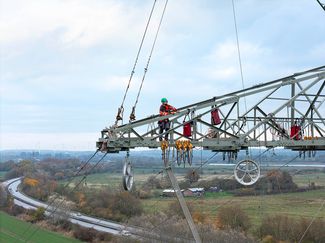
In addition to renewable electricity production plants and storage solutions, the energy system of the future will also need a reliable power grid to transport the electricity produced and stored to where it is needed. One of BKW’s strategic priorities with “Solutions 2030” is the expansion of the energy grids in Germany and Switzerland. LTB Leitungsbau GmbH from the BKW network is involved in the East Coast Line, currently one of the largest projects for the energy transition and grid stability in Germany. The East Coast Line is a 380-kilovolt extra-high-voltage line in Schleswig-Holstein that will transport electricity from the wind turbines on the Baltic coast to the high-demand south of the country and strengthen Germany’s connection to the European power grid. LTB has won various subcontracts in this major project. Among other things, it has erected 51 pylons on 22 of the total 120-kilometer line. LTB is also converting and upgrading existing power lines in Germany in order to be able to transport the increased amount of electricity from the north to the south in the future. The East Coast Line is scheduled to begin operation in 2028.
Comments